

Adventures in Japan, A Residency, and Reflections on Her Artistic Career: Catching Up with Ms. Williams After a Hard-Earned Sabbatical
By Sophie D. ‘26
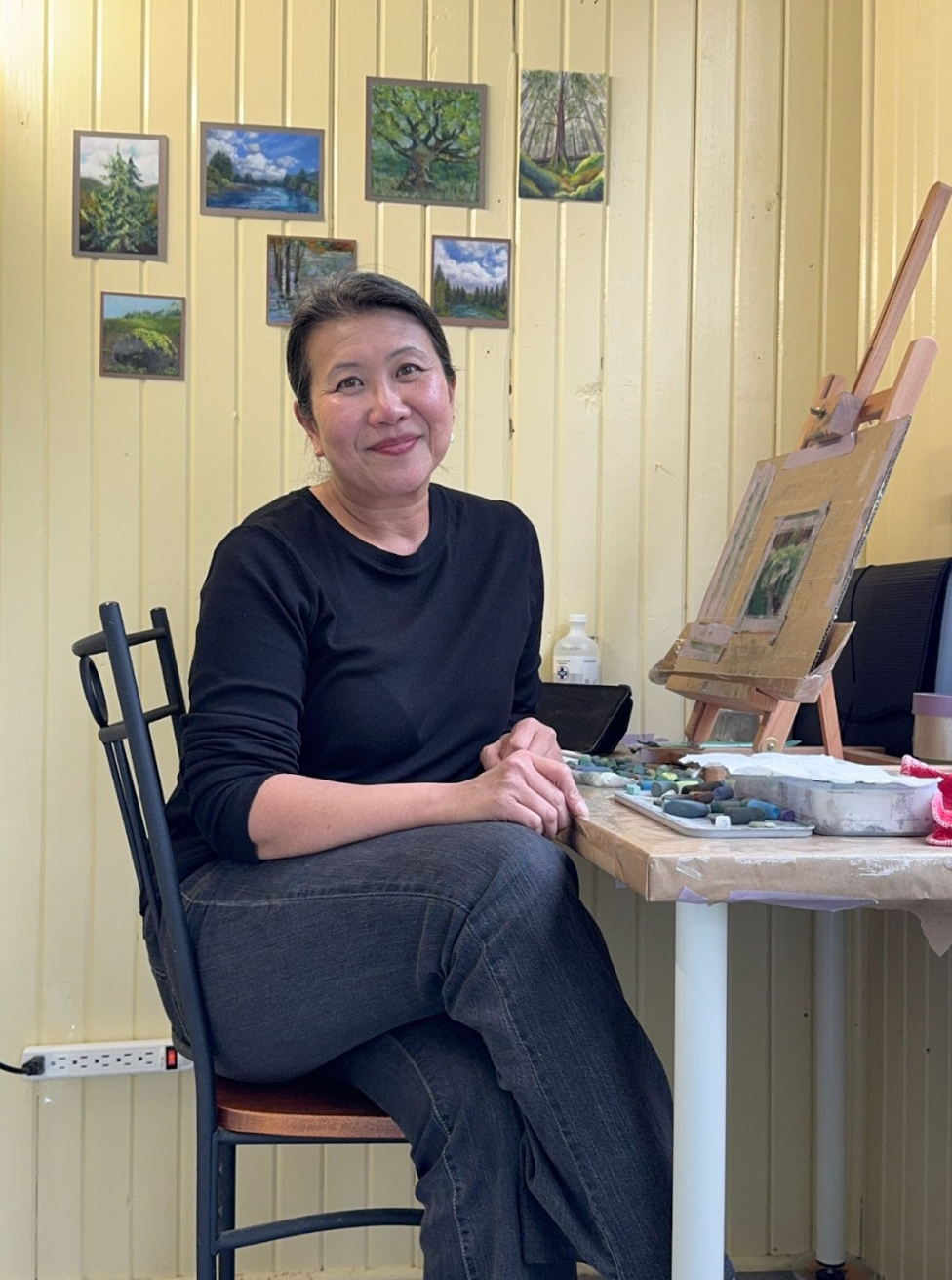
After almost 22 years at College Prep, visual arts teacher and lifelong artist Christina Williams took her sabbatical last Spring. Her activities included travel—a 10-day solo trip to Japan, a residency on Vancouver Island—and, of course, lots of art: indigo dying, sketching in her notebook, plein air, and more.
It’s been a pleasure to have Ms. Williams as my teacher, and as my advisor, for the past three years. Her calm presence makes her a great person to talk to, and her thoughtful feedback has undoubtedly made me a better artist. She is truly an expert in her field.
You, like me, might be wondering where all of Ms. William’s artistic experience and excellence came from. Check out this interview to learn about her artistic background, her path to CPS, and a few more interesting tidbits, like her favorite medium and favorite class to teach (spoiler alert: she doesn’t actually have one). Plus, get an in-depth look at her sabbatical through photos from her various artistic journeys!

Sophie: When did you start making art? When did you realize you wanted to be an artist full-time?
Ms. Williams: Hmmm, that’s a hard question to answer, because as far back as I can remember, I’ve been drawn to…drawing. I remember in either preschool or kindergarten, my teacher gave me a tip at the kiddie easel: paint with upward strokes to catch all of the dripping paint, so your painting doesn’t look messy. I saw another girl painting “wrong,” so I remember walking over and sharing my newfound tip with her. Already a teacher back then, haha!
I knew I wanted to major in art and have a career that was art-related when I was in high school, around junior year. At first I wanted to study fashion design, but that idea didn't last long. I really wanted to go to art college, but my parents weren't keen on that. The compromise was to go to a liberal arts college, and study all they had to offer, while majoring in art. I think my parents were secretly hoping I'd fall in love with a different subject and ditch art as a career.
Sophie: What led you to teach at CPS?
Ms. Williams: I came to teaching quite serendipitously. Beyond a brief student-teaching stint in grad school, I had no prior experience. It was a chance conversation at my undergraduate alma mater that led to a year-long teaching opportunity, and I fell in love with teaching art from then on.
After moving back to the Bay Area from New York, I knew I wanted to make teaching art a serious endeavor. So, I taught where I could, piecing part-time jobs together. Driving to the peninsula to teach at an elementary school five days a week in the morning, and a private art school two evenings a week; a few afternoons a week at an elementary school in Oakland for an after-school program, weekends at the College of Marin, and private lessons where I could fit them in. Some of the gigs barely paid for my gas, but I knew I had to take these positions to land something more steady. I was hustling trying to amass as much teaching experience as I could. Meanwhile, I designed lessons and courses, and kept my eye on listings for openings. The one at College Prep posted one day, so with my student work and personal portfolios, as well as my sample lessons, I interviewed and got the job. Fun fact: I was interviewing at Athenian at the same time too, but really hoped and wanted the one at Prep.

Sophie: What’s your favorite medium, and why? Has that medium always been your favorite, or has your preference changed over time?
Ms. Williams: My favorite medium to work in is soft pastel, and watercolor used to be a close second. I’ll try to make this short, because I can easily wax poetic about it. Soft pastel is the purest form of a color medium available in visual art. It has the least amount of binder, so a good soft pastel is mostly packed with pigment. This also means it’s much more lightfast (resistant to fading) than many other color mediums. Pastels have the most vibrant, but still natural, colors available. A good soft pastel is smooth and somewhat “buttery,” and there is something so primal about using your hands and fingers to manipulate it. It’s like touching “earth”: incredibly grounding. There’s nothing between you and the medium—at least that’s how I paint. It does smear quite easily if not fixed, but I think it’s still lovely.
While soft pastel remains solidly embedded as #1 for me, I recently started oil painting, and I am quite enamored with it. I can see why so many pastel artists actually paint in oils (and vice versa). While I have not been classically trained in oils, it has felt quite natural to switch over. It’s a bit like playing the flute: one can fairly easily switch to playing the saxophone because the keying is somewhat similar.

Sophie: I know you take commissions–tell us more about your own art practice!
Ms. Williams: Most of my focused art making happens during school breaks, especially in the summer. I start with taking lots of photos, all the time, whenever I’m out. If anything catches my eye, I photograph it. I have gobs of pictures of trees, sunsets, clouds, hills, mountains, leaves…it goes on and on.
As you can tell, I am mainly a landscape painter, though I do occasionally paint still lives and portraits. I will sift through the images, [and I] keep them all but will sort the ones that catch my eye most into separate themed folders. Once I find something that speaks to me—sometimes it’s an amalgamation of different images—I’ll do a quick value and compositional study, even turning down the saturation on a digital image. I like to work on colored ground and will lay out about four basic values in a color—usually burnt sienna. From there, I start laying in a base of colors and values and then continue working up the layers to build contrast, color, and texture. During the whole process, I will periodically step back and/or photograph it to look with a more discerning eye, and will often ask my husband (who is also an artist) to look at it and get his critical feedback. It is very important to get another set of eyes on it and to hear how it’s being seen.I do not have an agent or gallery representation. I do show in a local SF gallery biannually for a couple of specific shows. Otherwise, most of my exhibits are through calls for submissions, usually for juried shows from art societies that I belong to and other random calls from galleries nationwide. Most of my commissions come from word of mouth. Someone has a piece I made, their friend or family member sees it and likes it, and they reach out to me. Maybe one day I will have gallery representation, but since I enjoy my day job, it’s not a priority of mine to produce the extensive body of work that would be required to attract a reputable gallerist or art agent. I quite like the word of mouth commissions because I am interacting one-on-one with the client.

Sophie: Do you have a favorite project or technique to teach? (e.g. 2-point perspective, still life unit, figure drawing…)
Ms. Williams: I don’t think I have a favorite thing to teach, because it’s so much fun to share all the ways to make art! But if I HAD to choose one… I guess I’d have to go with contour line drawing, because it is where I most often see a student’s confidence show up. It’s incredibly rewarding to watch an inexperienced student discover, with just a few simple instructions, how to truly look, so that they can suddenly see contours and create a drawing with real dimension and likeness to their reference.
Sophie: What’s your favorite class to teach, and why? (This is probably a tough one, so feel free to say something you like about each class instead!)
Ms. Williams: Hmmm, this one is like asking me what my favorite food is, haha! I like them all for different reasons.
D&D: I watch students discover their artistic capabilities and see their self confidence grow as they become more comfortable creating, and talking about, their work.Intermediate Art: I love seeing how these mid-level students begin to take the reins of their own artistic journey. There’s lots of discovery and experimentation—always fun to see what comes from it. Also, artistic conversations level up.Advanced Projects in Art: What a gift for a teacher to witness a student progress and grow into a more seasoned independent artist. It’s like watching the final latent image on photographic paper appear while it’s in the developing solution. And the critiques, check-ins, and general conversations about art are top level; real, honest, and thought provoking.Nexus: This class is structured so differently. There’s much more emphasis on designing and fabricating three dimensional things; it’s a little sculptural. It’s fun to tinker and make, with the help of fancy machines like the laser cutter and the 3D printer.

Sophie: Tell us about your sabbatical: travels, highlights, and new experiences! Did it live up to your expectations?
Ms. Williams: Sabbatical was an incredible gift of time. It did live up to my expectations in that I designed the pace of it deliberately and made sure I didn’t put too much pressure on myself to -fill in the blank- (create X amount of work by the end of, learn how to play ukulele like Jake Shimabukuro, or whatever other lofty goal I might have set). My agenda was to have something interesting going on for each month, for as much as I could plan. I gave myself some grace at the start (January) with simply decompressing my mind, and organizing my studio space. Then I went to Japan on my own for ten days in February, a trip filled with sashiko, indigo dyeing, and ceramic workshops. I took a local plein air workshop in March and then joined an artist residency on Vancouver Island in April. May brought me to another local plein air workshop, and I set aside June and July to concentrate on painting at my home studio and plein air as much as I could.
The beginning of August was left for getting my mind back into academics and lesson planning. I did a lot of hiking, drinking coffee at cafes, and sketching random people. I also went to see one of my pieces in an exhibit out of town, and visited many galleries and museums. All told, I managed to create 34 sketches, 13 soft pastels, 11 watercolors, and 8 oils.


Sophie: Finally, what advice would you give to students who want a career in the visual arts?
Ms. Williams: Broaden your view on what a career in the visual arts might look like. Yes, you can be the quintessential starving, angsty artist. But you do not need to starve. You will, however, need to put in your dues before making it “big,” and by big, I mean, however you want to define what success will look like for you.
The visual art field is so vast: from digital work in graphic design, to CG animation, to being an architect. You can make illustrations for a wide range of topics or genres. Want to be a photographer? There’s so much you can do with that, not just school portraits and wedding pictures. The glamorous stuff like sports or journalist photography is nice too, but there’s also merchandising, food, travel, commercial, and real estate to name a few. If you like art but don’t want to be a traditional artist in painting [or] sculpting then you can be an art conservator, work in a gallery or museum, or go into art therapy. There is so much that art “work” can fit itself into. And of course, you can find success as a full-time fine artist!


Comments